

Views: 199 Author: Site Editor Publish Time: 2026-02-16 Origin: Site


The offshore engineering environment is unforgiving, characterized by high corrosion rates, extreme hydrostatic pressure, and the constant need for massive stability against tidal forces. In this high-stakes arena, material failure can lead to catastrophic environmental damage and financial loss. It often surprises observers that engineers frequently select gray iron—a material with lower tensile strength than steel—for critical subsea and structural roles. This choice seems paradoxical given the availability of stronger ductile iron or fabricated steel options.
However, gray iron fills a specific, indispensable niche in marine engineering. It remains the superior choice for applications requiring massive compressive load-bearing capabilities, exceptional vibration damping in auxiliary machinery, and cost-efficient mass for stabilization. This article examines the technical rationale behind using ASTM A48 / DIN EN 1561 (GJL) classes in subsea ballast, engine room components, and static structures. You will discover how leveraging the unique physics of Gray Iron Casting solves complex stability and noise problems while significantly lowering the total cost of ownership.
Unmatched Damping: Gray iron’s flake graphite structure offers 5–10x better vibration damping than steel, critical for marine engine bedplates and pump housings.
Ballast Efficiency: With high density (7.2 g/cm³) and lower volume than concrete, gray iron reduces hydro-dynamic drag and simplifies subsea deployment.
Predictable Lifecycle: While susceptible to corrosion, its rate is linear and predictable (~0.25mm/year), allowing for calculated "corrosion allowances" without expensive coatings for certain applications.
Cost vs. Performance: Offers the lowest TCO for parts requiring high compressive strength and machinability, bypassing the higher processing costs of steel fabrication.
The decision to utilize gray iron in marine environments often comes down to internal microstructure. Unlike steel, which has a crystalline structure that transmits energy efficiently, gray iron contains graphite flakes dispersed throughout a pearlite or ferrite matrix. These flakes act as internal stress raisers and energy absorbers. When mechanical vibrations travel through the material, the graphite interfaces dissipate the energy as microscopic heat. This inherent property is non-negotiable for marine power generation systems.
Noise, Vibration, and Harshness (NVH) are critical concerns on offshore platforms and vessels. Engines, gensets, and large pumps generate immense vibrational energy that can cause fatigue failure in connecting pipework and structural frames. Steel weldments tend to "ring" and transmit these vibrations, effectively amplifying the problem. In contrast, components made from Vibration-Damping High-Temp Gray Iron Casting grades absorb this energy, deadening the noise and protecting sensitive equipment. The damping capacity of gray iron is approximately 5 to 10 times higher than that of steel, making it the standard material for engine blocks, bedplates, and gearboxes.
While gray iron is weaker than steel in tension, it excels in compression. In many grades, the compressive strength of gray iron is three to four times its tensile strength, often exceeding that of low-carbon steel. Marine engineers exploit this characteristic for gravity-based foundations, machinery mounts, and pile caps. In these applications, the primary load vector is downward (static weight) rather than tensile or dynamic. By aligning the component design with the material's compressive strength, engineers can create robust structures that are less expensive to manufacture than steel equivalents.
Marine engines operate under fluctuating loads, creating significant thermal stress. Gray iron possesses excellent thermal conductivity, allowing it to transfer heat away from combustion chambers and friction points efficiently. This capability prevents the formation of localized hot spots that lead to thermal cracking. For exhaust manifolds, turbocharger casings, and cylinder heads, this thermal diffusivity is vital for longevity, ensuring the machinery survives thousands of operational hours in a marine environment.
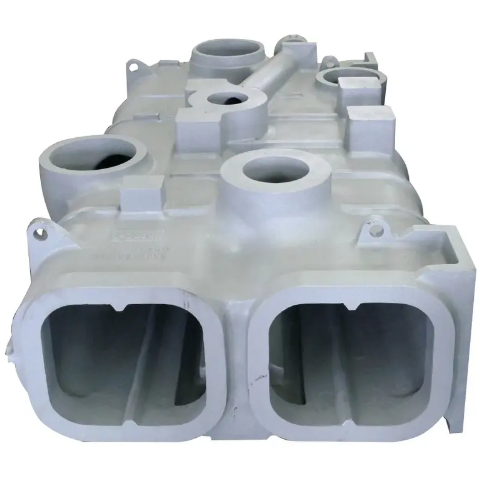
Material selection for offshore projects is often a trade-off between volume, density, and cost. While concrete is cheap and steel is strong, gray iron offers a density profile that solves specific hydrodynamic and spatial problems.
Stabilizing floating offshore wind platforms, tidal turbines, and mooring systems requires mass. Concrete is the traditional low-cost option, but its low density (~2.4 g/cm³) necessitates massive volumes to achieve the required weight. These large concrete structures increase hydrodynamic drag, subjecting the system to higher drift forces from currents. Lead is dense but toxic and prohibitively expensive.
The solution lies in General-Purpose Gray Iron Casting. With a density of approximately 7.2 g/cm³, gray iron ballast occupies roughly one-third of the volume of concrete for the same weight. This compactness results in a smaller seabed footprint and significantly reduced drag on mooring lines. Furthermore, high-density ballast weights often allow for "gravity base" deployment, where the sheer weight of the assembly holds it to the seabed, eliminating the need for expensive, noise-polluting seabed drilling or piling.
| Material | Density (g/cm³) | Hydrodynamic Impact | Cost Efficiency | Environmental Impact |
|---|---|---|---|---|
| Concrete | ~2.4 | High (Large Volume) | High (Low Material Cost) | Neutral |
| Lead | ~11.3 | Low (Small Volume) | Low (Very Expensive) | Negative (Toxic) |
| Gray Iron | ~7.2 | Low (Compact) | Medium (Best Value) | Positive (Inert/Recyclable) |
Inside the hull, gray iron is ubiquitous. Components such as cylinder liners, piston rings, and large pump housings rely on the tribological properties of the material. The graphite flakes exposed on the machined surface act as a solid lubricant. This self-lubricating property is essential for Abrasion-Resistant Gray Iron Casting Parts, reducing the risk of scuffing or seizing during periods of marginal lubrication (such as startup or shutdown). This wear resistance extends the service intervals for auxiliary equipment, a crucial factor for vessels operating in remote waters.
Subsea power cables and umbilicals require protection from tidal movement and seabed abrasion. Articulated pipes—interlocking half-shells made from gray iron—are clamped around cables to provide both armor and weight. These shells serve a "bend restriction" function, preventing the cable from bending beyond its minimum radius. The weight of the iron stabilizes the cable on the seabed, preventing it from washing away in strong currents, while the casting's hardness resists abrasion from shifting sands and rocks.
When analyzing the Total Cost of Ownership (TCO), gray iron frequently outperforms fabricated steel, particularly for complex geometries and heavy-section parts.
The gray iron casting cost is generally lower than that of steel fabrication for several reasons. First, gray iron has a lower melting point than steel, resulting in lower energy consumption during the smelting process. Second, casting allows for near-net-shape manufacturing. A complex shape that might require cutting, bending, and welding dozens of steel plates can be cast as a single monolithic unit. This eliminates the labor-intensive welding process and the need for non-destructive testing (NDT) on every weld seam.
Processing costs are further reduced during the machining phase. The graphite flakes in gray iron act as natural chip breakers, causing the metal to shear off in small, manageable chips rather than long, stringy ribbons. This characteristic allows for higher cutting speeds and significantly extends the life of cutting tools. For Custom Gray Iron Castings that require precision facing, such as large connecting flanges or mounting pads, the reduction in machining time directly translates to a lower unit price compared to steel or ductile iron.
Casting frees engineers from the geometric limitations of standard steel plate and beam sizes. Foundries can scale production from small 5kg valve bodies to massive 50-ton anchors or clump weights. The fluid nature of molten iron allows designers to place material exactly where it is needed for load-bearing and remove it where it is not, optimizing the weight-to-strength ratio. We see this scalability when analyzing the gray iron casting price for mass-produced items; the ability to use multi-cavity molds for smaller parts further drives down costs.
Sustainability is increasingly important in offshore project tenders. Gray iron ballast is frequently manufactured using recycled steel scrap (such as old car bodies or structural steel). Furthermore, at the end of a project's 20-25 year lifecycle, the iron components are 100% recyclable. They can be retrieved from the seabed and melted down to create new products, contributing to a circular economy and improving the project's overall carbon lifecycle assessment.
The skepticism regarding iron in saltwater is understandable. Without protection, iron corrodes. However, marine engineering manages this risk through predictable physics rather than avoidance.
Unprotected gray iron in seawater corrodes at a widely accepted rate of approximately 0.1 to 0.25 mm per year, depending on oxygen levels and water temperature. It also undergoes "graphitic corrosion," where the iron matrix leaches away, leaving the graphite structure behind. While this sounds detrimental, the rate is linear and highly predictable. Unlike the pitting corrosion seen in some stainless steels, which can cause sudden catastrophic failure, gray iron wastage is gradual.
For massive structural components like clump weights or gravity bases, engineers use a "corrosion allowance" strategy. Instead of applying expensive epoxy coatings that may chip during deployment, the design wall thickness is simply oversized. If a component needs a 50mm wall to handle the mechanical load for 20 years, and the corrosion rate is 0.2mm/year, the engineer adds 4mm (0.2mm * 20 years) to the design. The part is cast with a 54mm wall. This sacrificial layer is a cost-effective method for handling longevity in subsea environments.
For components requiring tighter tolerances, such as valve bodies or pump housings, allowing the material to rust away is not an option. Here, metallurgy plays a role. Foundries produce Abrasion-Resistant Gray Iron Casting Parts modified with small amounts of Chromium (Cr), Nickel (Ni), or Molybdenum (Mo). These alloys refine the pearlite matrix, tightening the grain structure and improving resistance to both corrosion and wear. For subsea static structures, external cathodic protection (sacrificial anodes made of zinc or aluminum) acts as the primary defense, halting the oxidation of the iron entirely.
Transparency is vital for safety. Gray iron is brittle. It has low ductility and poor impact resistance compared to steel or ductile iron. If an offshore component faces high tensile shock loads (e.g., a lifting lug subject to snatch loading) or requires significant elongation before failure, gray iron is not the correct choice. In these instances, engineers must specify Ductile Iron (GJS) or Cast Steel.
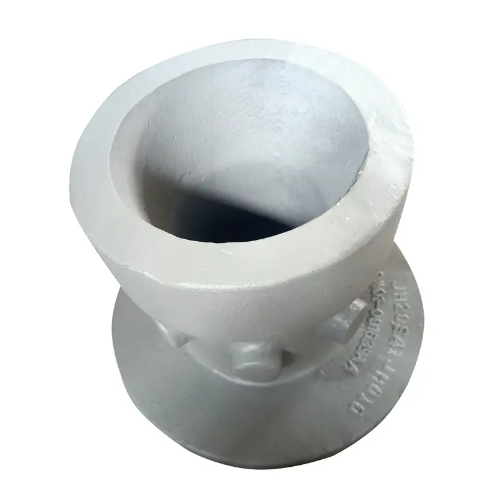
Choosing the right partner is as critical as choosing the right grade. The offshore industry demands traceability and consistency.
Not all foundries can produce the massive components required for offshore wind or oil and gas. When evaluating a gray iron casting supplier, assess their capacity for heavy-section castings. Can they pour 10-ton or 20-ton single pieces? Large castings cool differently than small ones; improper cooling leads to internal shrinkage and porosity. A capable foundry will use simulation software to predict solidification patterns.
Metallurgical control is equally important. The supplier must possess on-site spectrometers to verify the Carbon Equivalent (CE) and alloy consistency of every melt. This ensures the final casting meets the specific class requirements for strength and damping.
Strict adherence to international standards is mandatory. Buyers should demand compliance with ASTM A48 (USA) or DIN EN 1561 (Europe). For pressure-retaining parts like valves, simple visual inspection is insufficient. Reliable grey iron casting services will include Non-Destructive Testing (NDT) protocols. Ultrasonic Testing (UT) or Magnetic Particle Inspection (MPI) must be used to detect subsurface porosity or cracks that could propagate under high hydrostatic pressure. Sourcing Rugged High-Precision Gray Iron Castings requires a supplier who provides full documentation and material certifications.
Finally, logistics play a massive role in the final cost. Iron ballast is heavy. If the foundry is located deep inland, the cost of overland transport to the port can negate the material cost savings. Ideal partners are located near major shipping hubs, allowing for direct loading of heavy components onto vessels.
Gray iron is not merely a "cheap substitute" for steel; it is an engineered material that solves specific physics challenges inherent to the offshore environment. Its ability to dampen vibration protects sensitive engine room machinery, while its high density and compressive strength provide the stabilization necessary for subsea structures. By understanding the linear nature of its corrosion and designing appropriate allowances, engineers can deploy this material safely and effectively.
The decision logic is clear: if the primary load is compressive, if the environment requires vibration damping, or if mass is an asset for ballast, gray iron is the optimal choice. We encourage engineers to consult with metallurgical experts early in the design phase to optimize wall thickness, grade selection, and casting geometry. For those seeking reliable manufacturing partners, exploring gray iron casting supplier options with proven marine experience is the first step toward a successful project.
A: Yes, provided a corrosion allowance is calculated or cathodic protection is used. It is standard for ballast, clump weights, and pump housings. While it corrodes, the rate is predictable (approx. 0.1–0.25 mm/year), allowing engineers to design thicker walls to ensure the component lasts for the full project lifecycle without structural failure.
A: The main difference is ductility. Ductile iron bends under stress; gray iron breaks. Ductile iron is used for components facing tensile loads or shock impacts (like lifting points). Gray iron is used for compressive loads, vibration damping (engines), and static weight (ballast) due to its superior cost-efficiency and damping properties.
A: Gray iron casting is generally 20-40% cheaper than steel fabrication for complex shapes. This savings comes from the elimination of labor-intensive welding, reduced energy costs during melting, and near-net-shape casting which significantly reduces machining time and material waste.
A: Marine applications typically use Class 30 to Class 40 (ASTM A48) or EN-GJL-200 to EN-GJL-300. These grades offer an optimal balance of compressive strength, wear resistance, and machinability. Lower grades may be used for simple ballast weights where strength is less critical than mass.


